
Note: This is a sponsored post from Vaseat and may contain links to their website, which are included for the reader’s reference.
Most people buy home-office chairs the way they buy a sofa: by look, in about ten minutes. Three weeks later, the seat is too deep, the armrests hit the desk, and the chair never quite tucks away.
Choosing an ergonomic chair that works in a real home takes four measurements and one honest test sit. Here is how to do it.
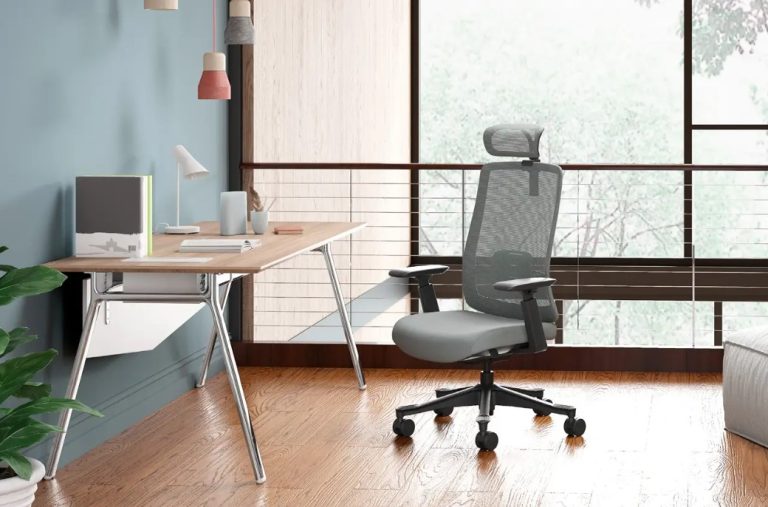
Measure before you browse
Write down these four numbers.
- The height of your desktop
- The clearance beneath it, measured to the lowest point of any drawer or apron; this decides whether the armrests can slide under
- The width of the gap the chair has to pass through to reach the desk
- The depth of free floor behind the desk
Compare these measurements to the chair’s full dimensions, not just the seat. A five-star base is typically 60 to 70 cm across, and you need roughly a metre behind the desk to push back, stand, and recline without touching a wall. If your current chair already passes these checks, you may only need to adjust it.
Note the desk height especially. Most desks are fixed at 72 to 75 cm, which suits someone around 1.80 m; if you are shorter, you’ll need to raise the seat and use a footrest, and it is better to know that before ordering than after delivery.
Get all the info you need about our eDesign services
Download our free Gal at Home® eDesign Experience brochure and learn our services, rates, timelines, visual samples of our deliverables, actual client testimonials...and more!
Thank you!
You have successfully joined our subscriber list.
Check how the chair fits your body
Sit in it for 15 minutes, ideally at a desk the height of yours, and run through four points.
Height: Feet flat on the floor, knees at roughly a right angle. If the desk forces the seat higher, a footrest restores the angle.
Depth: Sit fully back and check for two or three fingers of space between the seat edge and the backs of your knees; a sliding seat makes this adjustable.
Lumbar: The curve of the backrest should sit at belt level, not at the shoulder blades.
Armrests: Set to desk height, they should carry your forearms without lifting your shoulders.
Recline: Lean back, lock the backrest and push against it: it should hold without creeping and release without a fight. If there is a tension knob, turn it end to end and check the resistance actually changes.
Ask for a demonstration of every lever. A feature you cannot find or set without a manual is a feature you will never use.
Choose materials and colours that suit your home
Mesh suits a warm room because air passes through it; a padded seat suits a cool one. Either way, ask how it is cleaned, especially if the desk sits near a kitchen or doubles as a craft table. For color, repeat something already in the room, and remember that the frame counts as much as the fabric: a white frame disappears against pale cabinetry, a black one ties in with a metal desk or lamp.
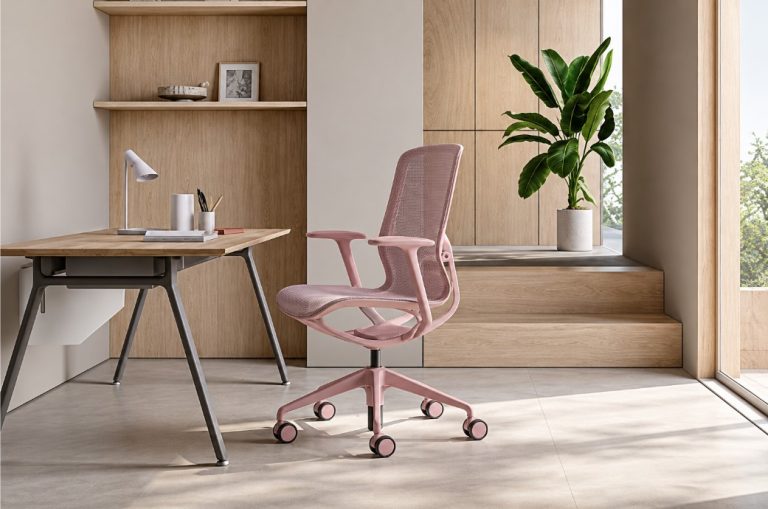
Leave enough room to move
Before ordering, mark the chair’s footprint on the floor with masking tape, then walk past it, pull it back and sit down as you would on a working day. In a flat or a shared room, this five-minute test prevents most returns.
A thick rug makes rolling awkward: ask which castors suit your floor, or add a chair mat. Keep cables away from the wheels and leave the space under the desk for your legs; a basket beside the desk beats a box beneath it.
Ask what supports the ergonomic label
The word ergonomic has no legal definition. What matters is the specification sheet: seat height range, seat depth, rated user weight, warranty length and the availability of spare parts such as the gas lift and castors. Five years on the mechanism is a reasonable warranty to expect; a gas lift sold separately means the most common failure is a twenty-minute repair rather than a new chair.
ANSI/BIFMA X5.1 is the standard used to test the safety, durability and strength of office chairs. Ask whether the test covered the complete chair in the configuration you are buying; a test on a single component proves nothing about the whole. And remember that a durability test cannot tell you whether a chair fits your body, which is why the test sit matters.
For context on the companies behind the chairs, this guide to office chair manufacturers worldwide is a useful starting point for a shortlist. Verify individual models with the seller, and weigh local availability, delivery costs and warranty support before deciding.
The chair that works in a real home is the one that passed four measurements and a fifteen-minute test sit, not the one that looked best in the photo. Measure first, sit second, and ask for the paperwork before you pay.
Join the exclusive Gal at Home email list!
Sign up for my emails sent weekly to your inbox! I also share my musings about creating homes we love and enjoy living in, and actionable DIY interior styling and design tips and techniques you can use in your own homes.
Thank you!
You have successfully joined our subscriber list. Please check your inbox to confirm your subscription.
Note: This is a sponsored post from Vaseat and may contain links to their website, which are included for the reader’s reference.
All images are courtesy of Vaseat. This is published on Gal at Home as part of our commitment to share diverse perspectives on topics such as self and well-being, relationships and community, home design and DIY, career and creativity, and lifestyle and leisure. It may contain links to the author’s or their clients’ websites, which are included for the reader’s reference.
The views and opinions expressed in this article are those of the author and do not necessarily reflect the views, policies, or positions of Gal at Home Design Studio.